

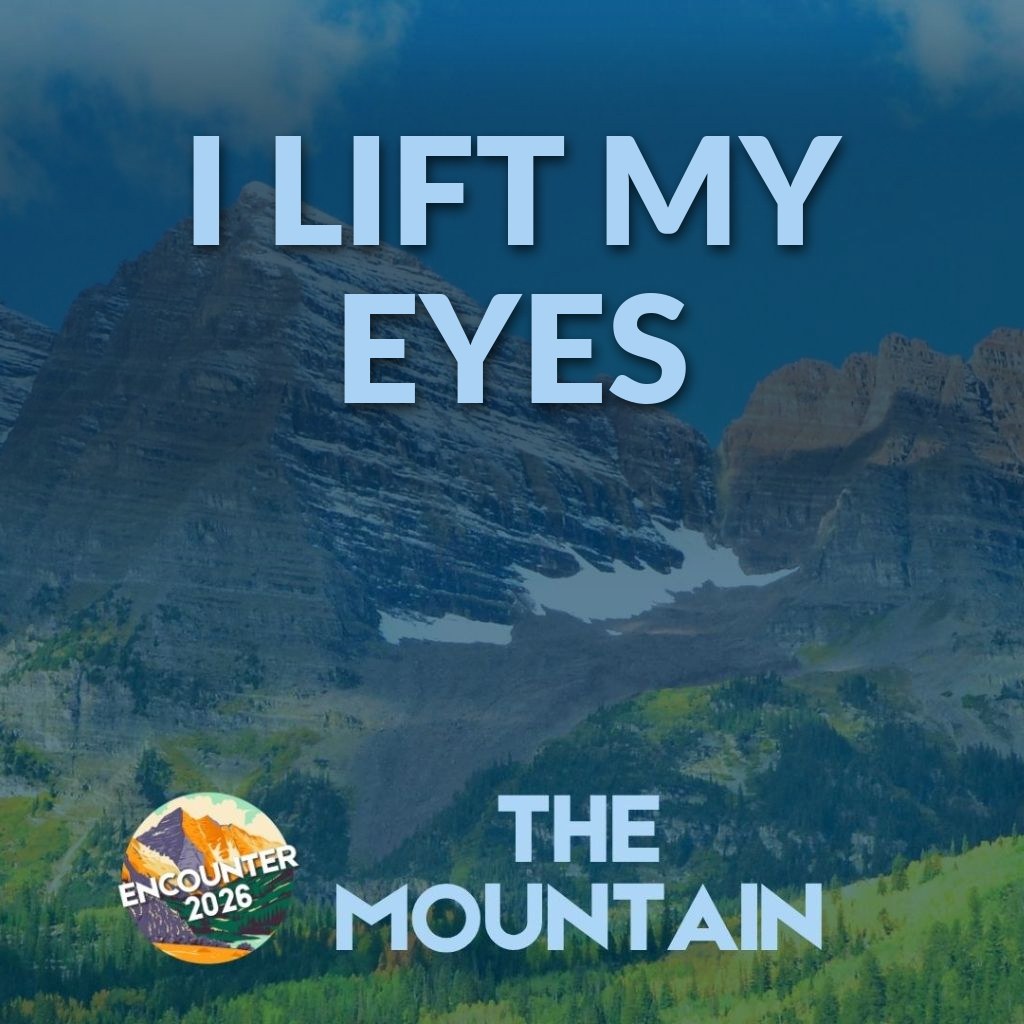
Tuesday, August 18, 2026 | The Mountain, Week 3
Devotional Thought
“I look up to the mountains — does my help come from there? My help comes from the LORD, who made heaven and earth!”
Psalm 121:1–2, NLT
Psalm 121 is one of the most quoted psalms in the Bible and one of the most misread. Most of us hear I look up to the mountains, does my help come from there? and we assume the answer is yes — the mountains are majestic, God is majestic, we lift our eyes and find help in the view. That’s a sweet reading and it has been on a thousand greeting cards. It also misses the point.
Read the psalm again. I look up to the mountains — does my help come from there? That’s a question, and it’s a real one. In the ancient world, mountains were not just scenery. They were where the pagan high places sat. They were where other peoples built shrines to other gods. When a traveler on the road to Jerusalem looked up at the hills around him, he was looking at the actual addresses of every false god in the region. The psalmist is asking, with a little edge in his voice: is this where my help is? And then he answers his own question with relief. No. My help comes from the LORD, who made heaven and earth.
That answer is the whole game. The God who helps the psalmist is not local. He is not one option among many on the surrounding hills. He is the maker of heaven and earth — the One who built every mountain the psalmist is staring at. The help the traveler needs comes from a higher source than the highest hill, and that source has a name.
This matters this week, because we are talking about climbing mountains, and there is a quiet danger in our kind of spirituality: we can start to trust the climb itself. We can mistake the experience for the source. We can come down from a moving worship service or a powerful prayer time and start to think the mountain gave us the help — when in fact the help came from the God who built the mountain and waited for us at the top. Take the mountain away, and the help would still be there. It comes from him.
Look at the second half of the psalm. He will not let you stumble. The LORD himself watches over you. He stands beside you as your protective shade. The sun will not harm you by day, nor the moon at night. The LORD keeps you from all harm and watches over your life. The LORD keeps watch over you as you come and go, both now and forever. Count the verbs. Watches over. Watches over. Watches over. The traveler is not alone on the road. The God who made the mountains is the one walking beside him.
So today, when you lift your eyes — and you will lift them, because everybody is looking up at something — make sure you’re looking past the hill. The hill isn’t the help. The God who built it is. My help comes from the LORD, who made heaven and earth. Say it slowly enough to mean it.
Going Deeper
Scripture Reading
Psalm 121, NLT (the full psalm — only eight verses)
Historical Context
Psalm 121 is the second of the fifteen “Psalms of Ascent” (Psalms 120–134), a collection sung by pilgrims as they made their way up to Jerusalem for the great festivals. The road to Jerusalem was uphill, often dangerous, with hills hiding bandits and the heat of the day pressing down. Psalm 121 is a traveler’s psalm — almost certainly sung in call-and-response between two voices, one asking and one answering. The “mountains” the pilgrim looks at would have included not just Mount Zion ahead but every surrounding hill, many of which still held shrines to local deities.
Literary Context
The psalm has a deliberate two-voice structure. Verses 1–2 are spoken by the pilgrim (“I look up… my help comes…”). Verses 3–8 are spoken to the pilgrim (“He will not let you stumble…”). It’s an antiphon — a question answered by a blessing. The pilgrim names his anxiety, and a second voice — perhaps a priest, perhaps a companion, perhaps God himself through the worshipping community — answers with assurance, repeating the word watches over four times.
Theological Context
Psalm 121 sits inside the great biblical theme of the keeping God — the God who is faithful to his covenant people in their actual travels. The word translated watches over is the Hebrew shamar, which is the same verb God uses in Genesis 2 when he tells Adam to keep the garden, and the same verb in the priestly blessing of Numbers 6:24 (“the LORD bless you and keep you”). It signals attentive, protective, ongoing care. The psalm is not promising the pilgrim that nothing bad will happen on the road. It is promising that, in everything that happens, the God who made heaven and earth has his eye on him.
Key Insights
- I look up to the mountains — does my help come from there? is a question, not a statement. The psalmist is testing his own instincts.
- The help comes from the God who made the mountains, not from the mountains themselves. The maker outranks the made.
- The verb watches over (Hebrew shamar) appears four times in eight verses. God’s care is not a one-time event — it is a posture.
- The psalm is for the road, not for the resting place. It is sung while traveling, by people who are not yet home.
Looking In the Mirror
- What “mountain” have you been looking to lately for help — a person, a paycheck, a plan, a habit? Be specific. What would it cost to admit that the help has been coming from there?
- The God who watches over you is the God who made heaven and earth. Does the size of the God you actually pray to match the size of the God this psalm is describing?
- He will not let you stumble. When you read that line honestly, do you believe it about your own life? If not, where has belief leaked out?
Guided Prayer
LORD, I lift my eyes today. I want to look past the hills to you. I’ve been looking for help in a lot of places lately — some of them sensible, some of them small — and I am tired of help that runs out. You made heaven and earth. You watch over me as I come and go. Walk beside me on this road. Be the shade. Be the keeper. Be the source. Amen.
Leave a Reply