

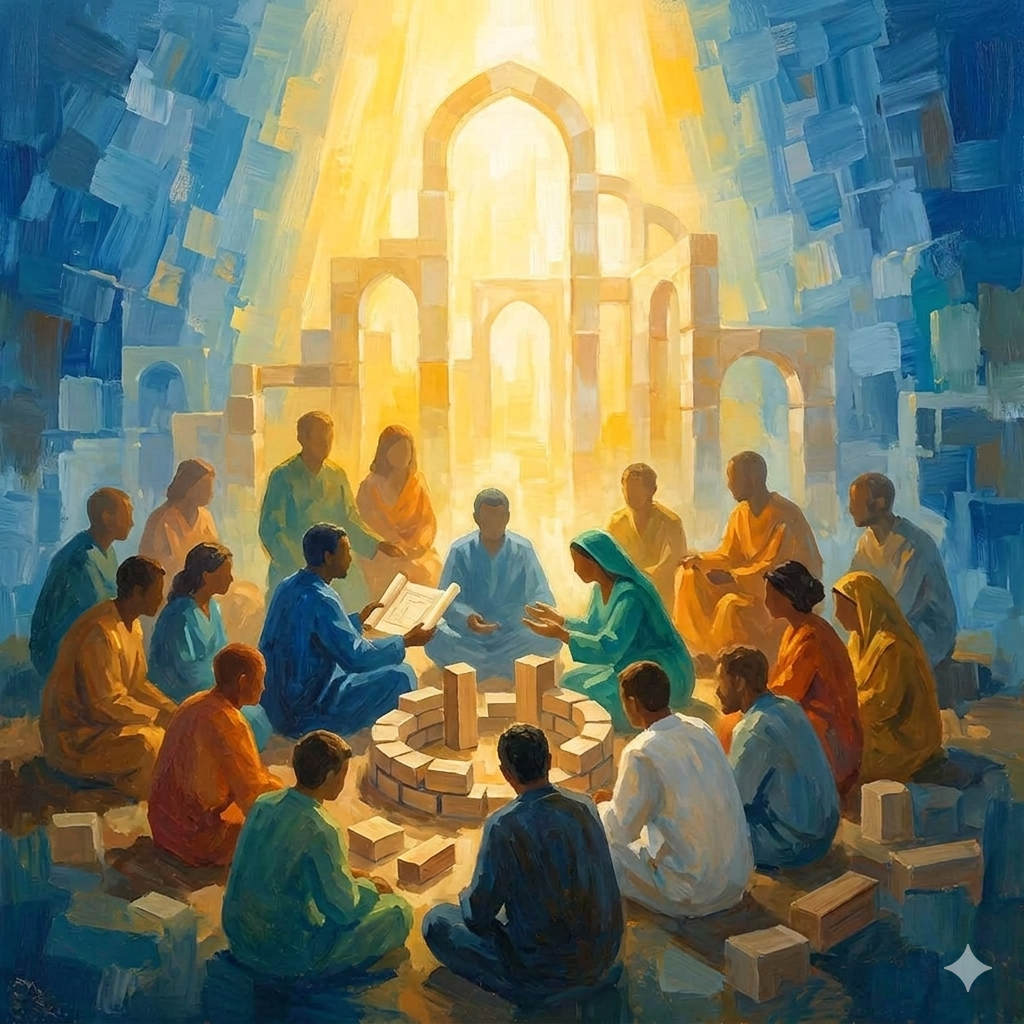
You’re not just attending something — you’re becoming something.
Devotional Thought
“You are coming to Christ, who is the living cornerstone of God’s temple. He was rejected by people, but he was chosen by God for great honor. And you are living stones that God is building into his spiritual temple.”
1 Peter 2:4–5a, NLT
Peter wrote this to people who had every reason to feel like rubble.
They were scattered across what is now Turkey — displaced, marginalized, described in chapter one as “foreigners and exiles.” These are not people at the center of anything. And yet Peter calls them living stones. Not passive, not ornamental — living. Stones with the Spirit in them. Stones being shaped and set.
The cornerstone image is doing a lot of work here. A cornerstone in ancient construction wasn’t decorative — it was load-bearing. It set the angle, established the lines, determined the shape of everything built relative to it. To say Christ is the cornerstone is to say that every other stone finds its position, its angle, its purpose in relationship to him. You can’t figure out where you belong by looking at yourself alone. You find your place in relation to him — and, by extension, in relation to the others being built alongside you.
What strikes me about this passage is how material it is. The Spirit isn’t building an abstraction. He’s building a temple — which in the ancient world meant a place where heaven and earth met, where God’s presence dwelled among his people. Peter is saying: that’s you. That’s what you are becoming. Not a building of stone and mortar, but a community so shaped by the Spirit that when people encounter you, they encounter the presence of the living God.
That’s a staggering claim for a group of scattered exiles. It’s a staggering claim for a mid-sized church in Angola, Indiana, too.
Going Deeper
Scripture Reading
1 Peter 2:2–10 (NLT) — 2 Like newborn babies, you must crave pure spiritual milk so that you will grow into a full experience of salvation. Cry out for this nourishment, 3 now that you have had a taste of the Lord’s kindness. 4 You are coming to Christ, who is the living cornerstone of God’s temple. He was rejected by people, but he was chosen by God for great honor. 5 And you are living stones that God is building into his spiritual temple. What’s more, you are his holy priests. Through the mediation of Jesus Christ, you offer spiritual sacrifices that please God. 6 As the Scriptures say, “I am placing a cornerstone in Jerusalem, chosen for great honor, and anyone who trusts in him will never be disgraced.” 7 Yes, you who trust him recognize the honor God has given him. But for those who reject him, “The stone that the builders rejected has now become the cornerstone.” 8 And, “He is the stone that makes people stumble, the rock that makes them fall.” They stumble because they do not obey God’s word, and so they meet the fate that was planned for them. 9 But you are not like that, for you are a chosen people. You are royal priests, a holy nation, God’s very own possession. As a result, you can show others the goodness of God, for he called you out of the darkness into his wonderful light. 10 “Once you had no identity as a people; now you are God’s people. Once you received no mercy; now you have received God’s mercy.”
Historical Context
First Peter is written to believers scattered across five Roman provinces in Asia Minor — people under social pressure and likely facing some degree of official hostility. Peter writes from Rome (called “Babylon” in 5:13) sometime in the 60s AD, before Nero’s persecution intensifies. His audience knows what it’s like to be on the outside of things. The living stones metaphor is not romantic — it’s pastoral. He’s giving people with no cultural standing a category for understanding who they actually are.
Literary Context
The passage draws heavily on Isaiah (28:16; 8:14) and Psalm 118:22 — the same Psalm Jesus quoted about the rejected stone becoming the cornerstone. Peter is weaving together a scriptural argument: the rejection that feels like the end of the story is actually the beginning of the building. The stone the builders threw away is exactly the one God chose. And you — the displaced, the pressured, the ones who feel thrown away — you are that kind of stone too.
Theological Context
The spiritual temple language here redefines what worship means after the resurrection. No longer is God’s presence housed in a building in Jerusalem — it is housed in a community. This is a radical claim with enormous implications: the church is not the place you go to encounter God; it is the community through which God makes himself present in the world. The Spirit’s work is not only personal formation but communal construction. We are being built together into something we could not be alone.
Key Insights
- “Living stones” are active, not passive. Being built into the church is something that happens to you and through you simultaneously.
- The cornerstone determines everything else’s position. You find your place in relation to Christ — and in relation to each other.
- The text moves from “you are” to “you were.” Verse 10: Once you had no identity as a people; now you are God’s people. The Spirit changes what is true about you, not just what you feel.
- A temple is a place of encounter between heaven and earth. That’s what a Spirit-filled community is. Not a religious club — a dwelling.
Looking In the Mirror
- Do you experience your faith community as a place you attend or a thing you are part of? What’s the difference in practice — what would have to change for you to live more like the second?
- Peter wrote to people who felt thrown away. Have you ever felt like a rejected stone — dismissed, overlooked, not quite fitting in the places that seemed to want certain kinds of people? What does it mean that God specifically uses that kind of stone?
- If your church community is a temple — a place where heaven and earth are meant to meet — what does that ask of you that mere attendance doesn’t?
Guided Prayer
Lord, I think I’ve been attending more than I’ve been becoming. I show up, I participate, and then I go home — mostly unchanged, mostly unchanged in relation to the people around me. I’m not sure I’ve thought of them as part of what you’re building in me. So today I’m asking you to make me more aware of the construction — the slow, unspectacular work of being shaped and placed. Help me find my position in relation to you, and in relation to the people you’ve set me next to. Build something in us that couldn’t be built from any of us alone. Amen.
Leave a Reply