

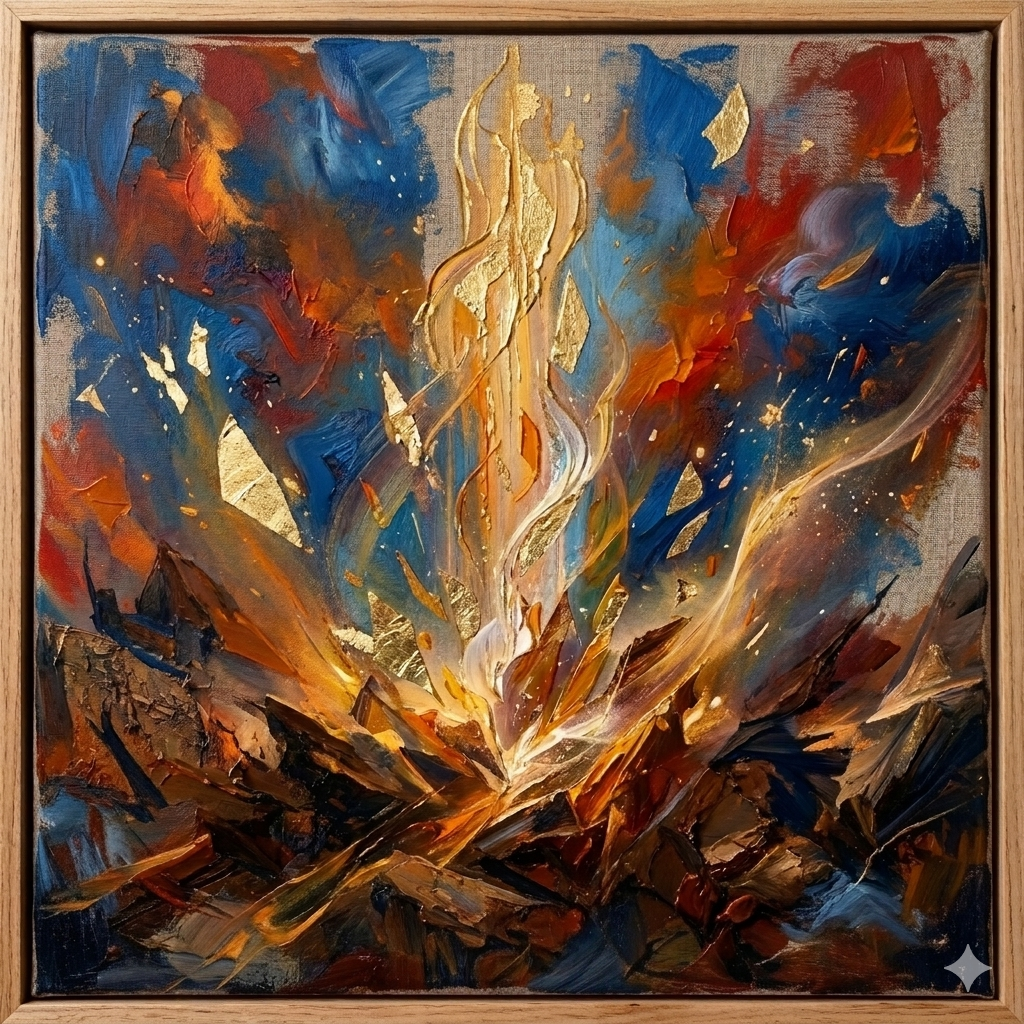
What Stephen saw — and what it cost him to say it.
Devotional Thought
“But Stephen, full of the Holy Spirit, gazed steadily into heaven and saw the glory of God, and he saw Jesus standing in the place of honor at God’s right hand.”
Acts 7:55, NLT
There’s a small word in this verse that carries a lot of weight: standing. Every other description of Jesus at the right hand of the Father has him seated — the posture of finished work, of rest, of reigning. Here, he’s standing. Many interpreters read this as Jesus rising to welcome Stephen home. But there’s another way to hear it: the Son of Man, standing as a witness. Stephen is about to die for his testimony, and Jesus is on his feet.
That image has stayed with me. Stephen is surrounded by people who want him dead, rocks already in hand, and what he sees is not rescue. He sees glory. He sees Jesus — not enthroned at a safe distance, but upright, present, attentive. Whatever is about to happen to Stephen is happening in full view of the one he’s dying for.
This is not an easy text to sit with. Stephen doesn’t get out of it. The stones fall. He dies. And the Spirit doesn’t intervene in the way we’d want a good story to end. What he gets instead is a vision — a seeing through that is somehow enough to let him say, Lord, don’t charge them with this sin, and then close his eyes.
That kind of dying takes a kind of living that most of us are still being formed into. Stephen was full of the Spirit before the stones came. The vision didn’t create the courage — it confirmed what was already there. The Spirit had been building something in him long before anyone in Jerusalem decided he was a problem.
We are not all Stephen. Most of us will not face anything like this. But the question his death leaves hanging in the air is worth carrying through the week: What has the Spirit been building in me that I haven’t had to spend yet?
Going Deeper
Scripture Reading
Acts 7:54–60 (NLT) — 54 The Jewish leaders were infuriated by Stephen’s accusation, and they shook their fists at him in rage. 55 But Stephen, full of the Holy Spirit, gazed steadily into heaven and saw the glory of God, and he saw Jesus standing in the place of honor at God’s right hand. 56 And he told them, “Look, I see the heavens opened and the Son of Man standing in the place of honor at God’s right hand!” 57 Then they put their hands over their ears and began shouting. They rushed at him 58 and dragged him out of the city and began to stone him. His accusers took off their coats and laid them at the feet of a young man named Saul. 59 As they stoned him, Stephen prayed, “Lord Jesus, receive my spirit.” 60 He fell to his knees, shouting, “Lord, don’t charge them with this sin!” And with that, he died.
Historical Context
Stephen is one of the seven men appointed in Acts 6 to serve the early Jerusalem church — men described as “full of the Spirit and wisdom.” He quickly becomes a public preacher and debater, drawing the attention of the Jewish council. Acts 7 records his long defense speech before the Sanhedrin — a retelling of Israel’s history that culminates in his accusation that the council has, like their ancestors, rejected God’s messengers. The speech gets him killed. His death, notably, is witnessed by a young man named Saul, who is holding the coats of the ones throwing stones (Acts 7:58; 8:1). The same Saul who will become Paul.
Literary Context
Acts 7:55–60 is the climax of a carefully constructed speech. Luke, the author of Acts, has spent the entire chapter setting up this moment: Stephen rehearses Israel’s pattern of rejecting God’s chosen leaders — Joseph, Moses — and then names Jesus as the culmination of that pattern. The vision of the Son of Man standing at God’s right hand (an echo of Daniel 7:13–14) is what finally breaks the council. Stephen’s death mirrors Jesus’ death in deliberate ways: the false witnesses, the trial, the prayer for his killers, the commending of his spirit. Luke is making a point: dying in step with Jesus is what it looks like to be fully alive in the Spirit.
Theological Context
Stephen’s death raises the question the whole New Testament wrestles with: why doesn’t God rescue the faithful? The Spirit is present — Stephen is described as full of the Holy Spirit — and yet no angel intervenes. What we see instead is the Spirit sustaining a man through something terrible, and the man emerging (if dying can be called emerging) more whole than broken. The theological territory here is the theology of the cross extended into the life of the church: the Spirit doesn’t always remove the stones. Sometimes he helps you look up while they fall.
Key Insights
- Stephen sees what the council cannot. Full sight requires the Spirit; without it, the same events look entirely different.
- Jesus standing at the right hand is unusual language — it suggests active witness, not passive rest. The Son of Man sees what is happening to his people.
- Stephen’s prayer for his killers (v. 60) is not heroism — it’s formation. The Spirit had been shaping this capacity in him long before it was needed.
- The presence of Saul at the execution is one of Luke’s most deliberate details. The church’s greatest persecutor will become its greatest missionary. God is building something even here.
Looking In the Mirror
- When you imagine God watching what’s happening in your life right now, do you picture him seated — distant, unmoved — or standing? What shapes that image for you?
- Is there something the Spirit has been forming in you that you haven’t had to spend yet — some courage, some capacity for forgiveness, some depth of trust that hasn’t been tested? What would it mean to live like that’s real?
- Stephen prays for the people killing him. Who in your life would be hardest to pray that prayer for? You don’t have to pray it today. But can you name them?
Guided Prayer
Lord, I don’t know what I would see if the ground fell out from under me. I’d like to think I’d see glory — see you, standing and present. But I’m honestly not sure. So form in me now what I’ll need then. Build the courage I can’t manufacture on my own. Shape the forgiveness that doesn’t come naturally. And on the days when I feel far from supernatural, remind me that Stephen was full of the Spirit before anyone threw a single stone. You were building something in him. You are building something in me. I trust that, even when I can’t see it. Amen.
Leave a Reply