

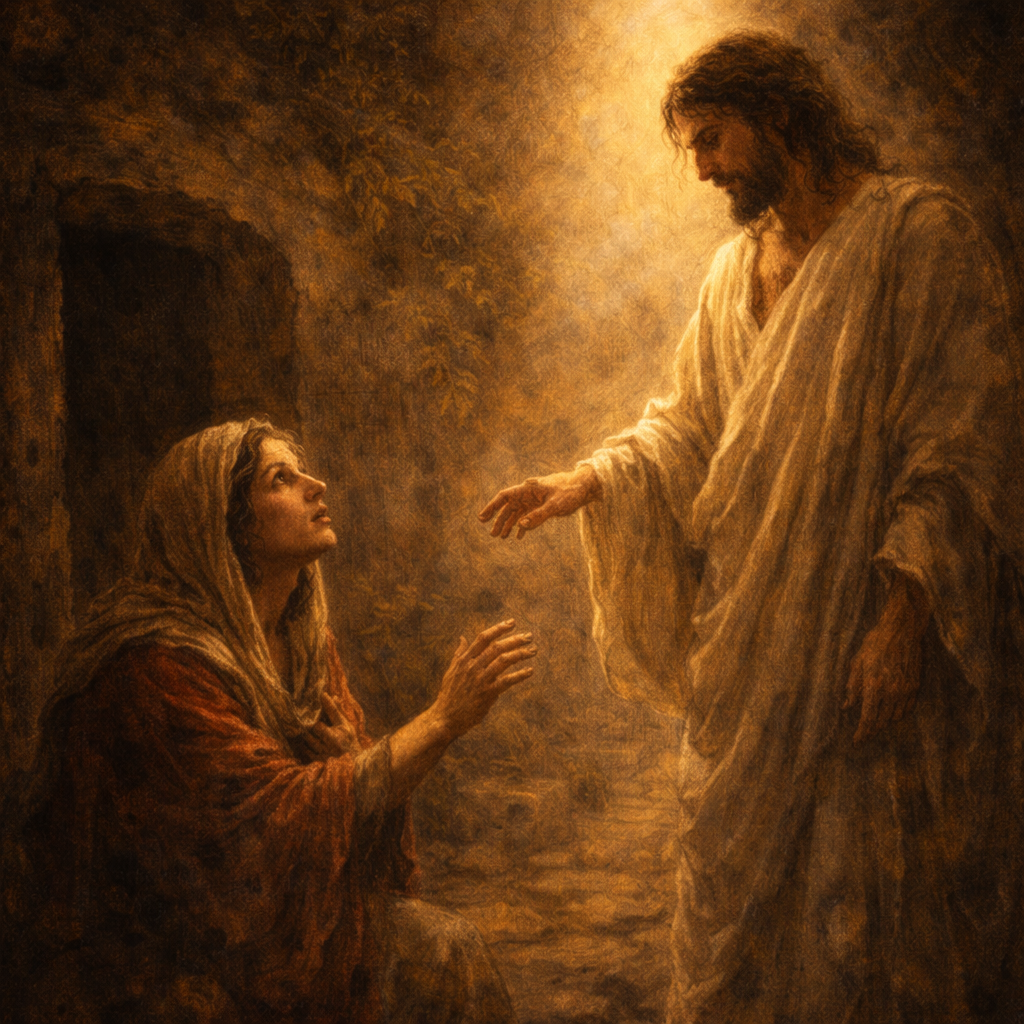
Thursday, April 9, 2026 – Recognition in the Garden (Alive Again — Living Resurrection Every Day)
Devotional Thought
Focus: John 20:16 (NLT) — 16 “Mary!” Jesus said. She turned to him and cried out, “Rabboni!” (which is Hebrew for “Teacher”).
Mary is standing right in front of Jesus and doesn’t recognize Him.
She assumes He’s the gardener.
She’s still operating out of grief, confusion, and expectation.
She knows what death looks like.
She does not yet know what resurrection looks like.
And honestly, that’s where many of us live.
We can be close to Jesus and still miss Him. Not because He’s absent—but because we’re looking for Him in the wrong way. Then everything changes with one word:
“Mary.”
Not a sermon.
Not an explanation.
Just her name.
And suddenly, recognition breaks through.
This is how resurrection often works.
Not through dramatic proof.
But through personal encounter.
Alive again means this:
Jesus doesn’t just rise—He comes near.
And He doesn’t just come near—He calls you by name.
Going Deeper
Scripture Reading
John 20:1–18 (NLT) — 1 Early on Sunday morning, while it was still dark, Mary Magdalene came to the tomb and found that the stone had been rolled away from the entrance. 2 She ran and found Simon Peter and the other disciple, the one whom Jesus loved. She said, “They have taken the Lord’s body out of the tomb, and we don’t know where they have put him!” 3 Peter and the other disciple started out for the tomb. 4 They were both running, but the other disciple outran Peter and reached the tomb first. 5 He stooped and looked in and saw the linen wrappings lying there, but he didn’t go in. 6 Then Simon Peter arrived and went inside. He also noticed the linen wrappings lying there, 7 while the cloth that had covered Jesus’ head was folded up and lying apart from the other wrappings. 8 Then the disciple who had reached the tomb first also went in, and he saw and believed—9 for until then they still hadn’t understood the Scriptures that said Jesus must rise from the dead. 10 Then they went home. 11 Mary was standing outside the tomb crying, and as she wept, she stooped and looked in. 12 She saw two white-robed angels, one sitting at the head and the other at the foot of the place where the body of Jesus had been lying. 13 “Dear woman, why are you crying?” the angels asked her. “Because they have taken away my Lord,” she replied, “and I don’t know where they have put him.” 14 She turned to leave and saw someone standing there. It was Jesus, but she didn’t recognize him. 15 “Dear woman, why are you crying?” Jesus asked her. “Who are you looking for?” She thought he was the gardener. “Sir,” she said, “if you have taken him away, tell me where you have put him, and I will go and get him.” 16 “Mary!” Jesus said. She turned to him and cried out, “Rabboni!” (which is Hebrew for “Teacher”). 17 “Don’t cling to me,” Jesus said, “for I haven’t yet ascended to the Father. But go find my brothers and tell them, ‘I am ascending to my Father and your Father, to my God and your God.’ ” 18 Mary Magdalene found the disciples and told them, “I have seen the Lord!” Then she gave them his message.
Historical Context
John’s Gospel presents a deeply personal account of the resurrection, focusing not on large crowds but on individual encounters.
Mary Magdalene becomes the first witness of the risen Jesus. This is a surprising and counter-cultural detail. It occurred in a time when women’s testimony was often dismissed.
This highlights how God often works through unexpected people and moments.
Literary Context
This passage moves through a series of scenes:
- The empty tomb
- The confusion of the disciples
- Mary’s grief outside the tomb
- The moment of recognition
John slows the story down to emphasize the emotional and relational turning point—recognition through relationship, not evidence alone.
Theological Context
This moment reveals something central to resurrection:
It is personal before it is proclamational.
Mary is not convinced by logic—she is awakened by relationship.
This reflects a broader truth:
Faith is not just about understanding—it is about encounter.
Key Insights
- Resurrection is often unrecognized at first—it meets us in familiar spaces.
- Grief can cloud our ability to see what God is doing.
- Jesus initiates recognition—He calls before we understand.
- Faith is rooted in relationship, not just information.
- The first witness of resurrection is someone who came looking for a body, not a miracle.
Looking In the Mirror
- Where might Jesus already be present in your life—but you haven’t recognized Him?
- What expectations might be shaping what you think God should look like?
- Are you open to encountering Jesus in unexpected ways?
- What would it look like to respond if you truly heard Him call your name?
Guided Prayer
Jesus,
Thank You that You come near—even when I don’t recognize You.
I confess that I often look for You in ways that feel familiar or predictable.
And sometimes, I miss You because I’m expecting something different.
But today, slow me down.
Help me become aware of Your presence in the middle of my ordinary life.
Speak to me in a way I can hear.
Call me by name—not because I deserve it, but because You love me.
And when You do, give me the courage to respond—
to turn toward You,
to trust You,
to follow You.
Amen.
Leave a Reply