

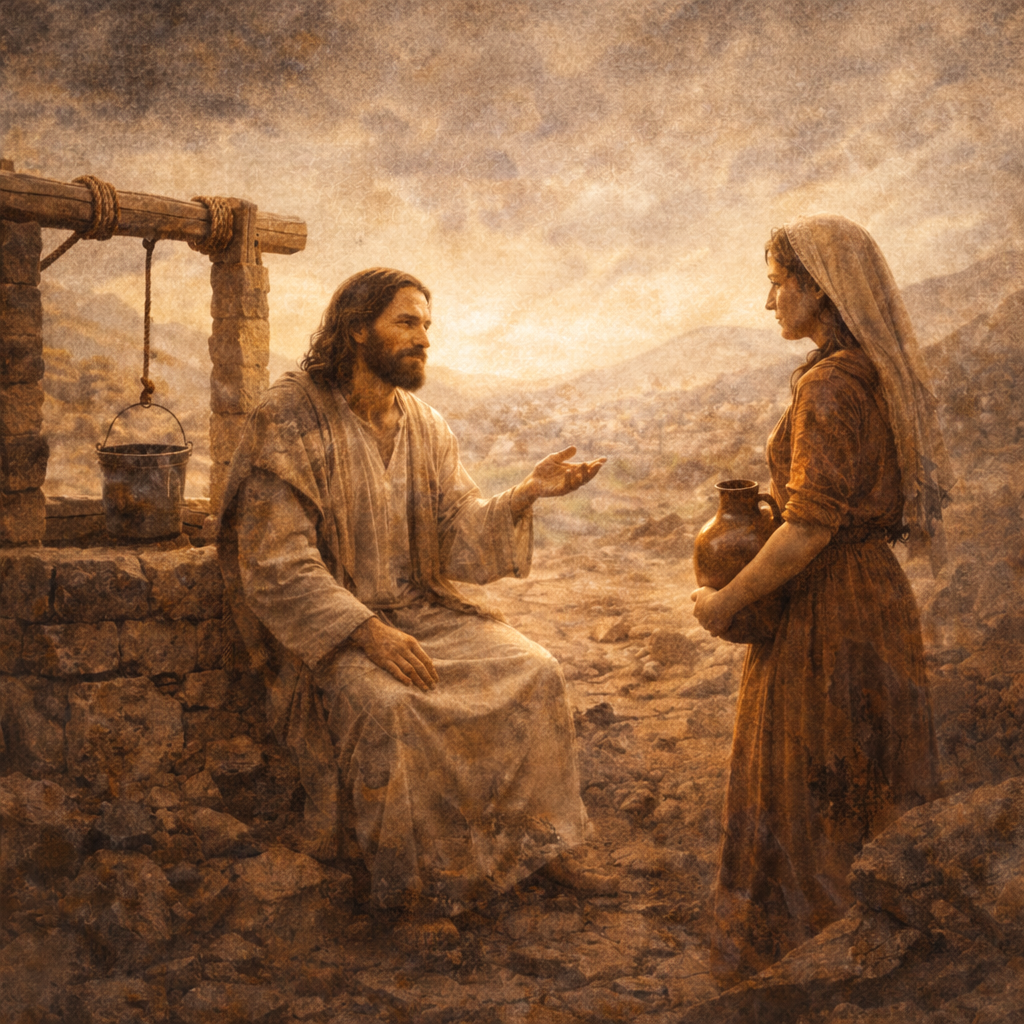
Thursday, March 12, 2026 – Jesus meets thirst with Himself.
Devotional Thought
Key Verse
“Whoever drinks the water I give them will never thirst.” — John 4:14
The Samaritan woman came to the well at noon. Not the cool of morning. Not when others gathered. Midday meant fewer eyes. Fewer questions. She came for water — but she was carrying more than a jar. Relational history. Social isolation. Spiritual confusion.
Jesus doesn’t begin with correction. He begins with thirst. “Give me a drink.” Then He turns the conversation: “If you knew the gift of God…”
She had been returning to the same well over and over. It met immediate need — but never lasting one. We do the same. We return to approval. To distraction. To control. To comfort habits. They hydrate for a moment. But the thirst returns.
Jesus does not shame her pattern. He offers Himself. Living water.
Not religion.
Not rule-keeping.
Not improved performance.
Presence.
Going Deeper
Scripture Reading
John 4:5–42 (NLT) — 5 Eventually he came to the Samaritan village of Sychar, near the field that Jacob gave to his son Joseph. 6 Jacob’s well was there; and Jesus, tired from the long walk, sat wearily beside the well about noontime. 7 Soon a Samaritan woman came to draw water, and Jesus said to her, “Please give me a drink.” 8 He was alone at the time because his disciples had gone into the village to buy some food. 9 The woman was surprised, for Jews refuse to have anything to do with Samaritans. She said to Jesus, “You are a Jew, and I am a Samaritan woman. Why are you asking me for a drink?” 10 Jesus replied, “If you only knew the gift God has for you and who you are speaking to, you would ask me, and I would give you living water.” 11 “But sir, you don’t have a rope or a bucket,” she said, “and this well is very deep. Where would you get this living water? 12 And besides, do you think you’re greater than our ancestor Jacob, who gave us this well? How can you offer better water than he and his sons and his animals enjoyed?” 13 Jesus replied, “Anyone who drinks this water will soon become thirsty again. 14 But those who drink the water I give will never be thirsty again. It becomes a fresh, bubbling spring within them, giving them eternal life.” 15 “Please, sir,” the woman said, “give me this water! Then I’ll never be thirsty again, and I won’t have to come here to get water.” 16 “Go and get your husband,” Jesus told her. 17 “I don’t have a husband,” the woman replied. Jesus said, “You’re right! You don’t have a husband—18 for you have had five husbands, and you aren’t even married to the man you’re living with now. You certainly spoke the truth!” 19 “Sir,” the woman said, “you must be a prophet. 20 So tell me, why is it that you Jews insist that Jerusalem is the only place of worship, while we Samaritans claim it is here at Mount Gerizim, where our ancestors worshiped?” 21 Jesus replied, “Believe me, dear woman, the time is coming when it will no longer matter whether you worship the Father on this mountain or in Jerusalem. 22 You Samaritans know very little about the one you worship, while we Jews know all about him, for salvation comes through the Jews. 23 But the time is coming—indeed it’s here now—when true worshipers will worship the Father in spirit and in truth. The Father is looking for those who will worship him that way. 24 For God is Spirit, so those who worship him must worship in spirit and in truth.” 25 The woman said, “I know the Messiah is coming—the one who is called Christ. When he comes, he will explain everything to us.” 26 Then Jesus told her, “I Am the Messiah!” 27 Just then his disciples came back. They were shocked to find him talking to a woman, but none of them had the nerve to ask, “What do you want with her?” or “Why are you talking to her?” 28 The woman left her water jar beside the well and ran back to the village, telling everyone, 29 “Come and see a man who told me everything I ever did! Could he possibly be the Messiah?” 30 So the people came streaming from the village to see him. 31 Meanwhile, the disciples were urging Jesus, “Rabbi, eat something.” 32 But Jesus replied, “I have a kind of food you know nothing about.” 33 “Did someone bring him food while we were gone?” the disciples asked each other. 34 Then Jesus explained: “My nourishment comes from doing the will of God, who sent me, and from finishing his work. 35 You know the saying, ‘Four months between planting and harvest.’ But I say, wake up and look around. The fields are already ripe for harvest. 36 The harvesters are paid good wages, and the fruit they harvest is people brought to eternal life. What joy awaits both the planter and the harvester alike! 37 You know the saying, ‘One plants and another harvests.’ And it’s true. 38 I sent you to harvest where you didn’t plant; others had already done the work, and now you will get to gather the harvest.” 39 Many Samaritans from the village believed in Jesus because the woman had said, “He told me everything I ever did!” 40 When they came out to see him, they begged him to stay in their village. So he stayed for two days, 41 long enough for many more to hear his message and believe. 42 Then they said to the woman, “Now we believe, not just because of what you told us, but because we have heard him ourselves. Now we know that he is indeed the Savior of the world.”
Historical Context
Jews and Samaritans had deep ethnic and theological tensions. For a Jewish rabbi to speak publicly with a Samaritan woman was culturally shocking. She was doubly marginalized — by ethnicity and by personal history.
Wells in the Old Testament often served as meeting places tied to covenant and promise (Genesis 24; 29; Exodus 2). John subtly echoes this imagery — but instead of a marriage proposal, Jesus offers restoration.
The Messiah is revealed not in Jerusalem first — but at a well in Samaria.
Literary Context
John structures this passage around misunderstanding and revelation. The woman initially interprets Jesus literally (physical water). Jesus speaks spiritually (living water).
The dialogue moves from:
- Physical thirst
- To personal exposure
- To theological debate
- To communal testimony
By the end, she leaves her jar behind. That detail matters. The thing she came for becomes secondary to the One she found.
Theological Context
Living water represents the life of the Spirit — internal, renewing, ongoing. Unlike the rock struck once in Exodus, Jesus Himself becomes the ongoing source.
Theologically, this passage reveals:
- Jesus as the true temple
- Jesus as the source of eternal life
- Jesus as the one who satisfies what rituals cannot
Thirst is not eliminated by effort. It is satisfied by relationship.
Key Insights
- Repeated return to the same well reveals deeper thirst.
- Jesus meets people personally, not abstractly.
- Living water is internal and enduring.
- True satisfaction flows from presence, not performance.
Looking In the Mirror
Where do you keep going back for relief?
What well do you revisit when you feel dry?
Does it actually satisfy — or simply delay thirst?
Imagine leaving the jar behind.
What would it look like to receive Jesus not as supplement — but as source?
Pray today: “Lord, meet my thirst with Yourself.”
Leave a Reply