

Monday, March 9, 2026 – Dry places reveal what we believe about God
Devotional Thought
Key Verse
“Why did you bring us up out of Egypt to make us and our children and livestock die of thirst?” — Exodus 17:3
Israel is not in rebellion. They are thirsty. And thirst has a way of shrinking our memory.
Just chapters earlier, they walked through the Red Sea. They sang songs of deliverance. They watched God provide manna in the wilderness. But now the water is gone. And suddenly the story changes: “You brought us out here to die.”
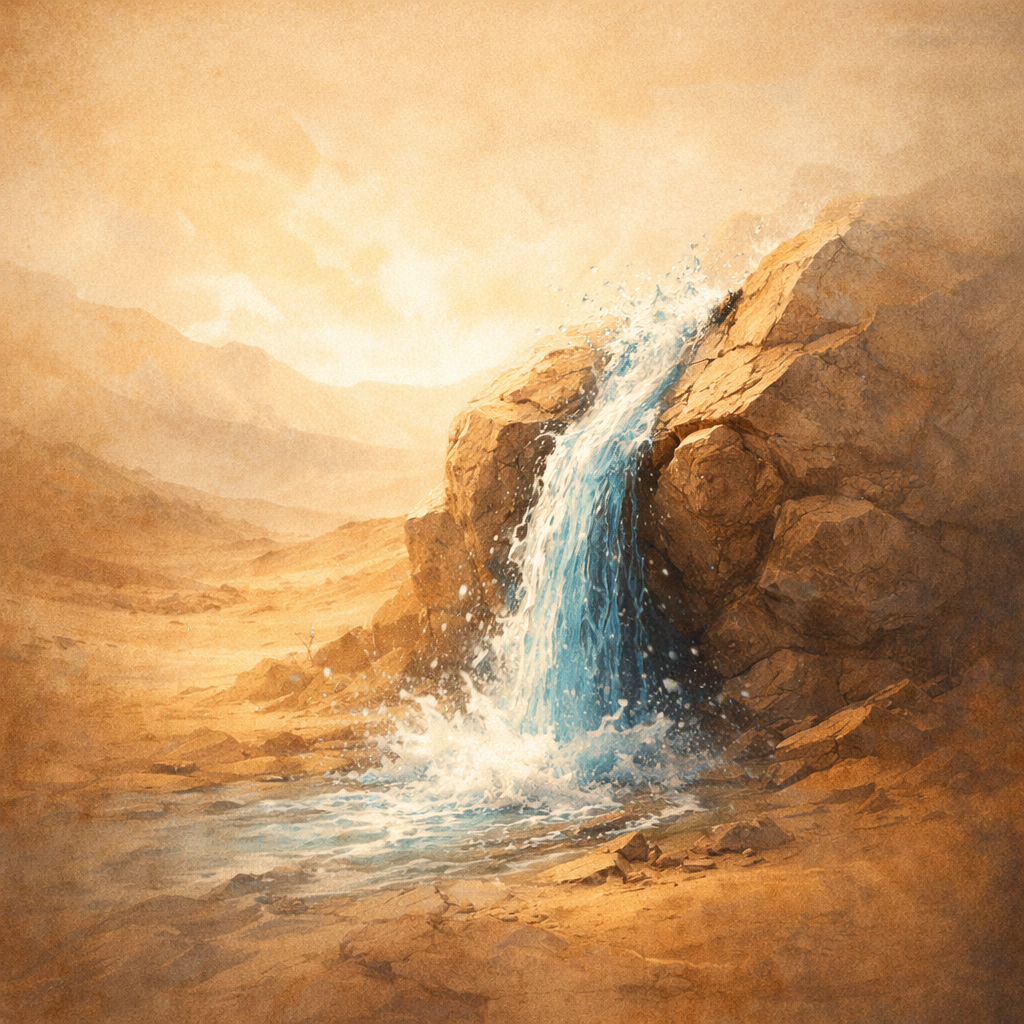
Thirst does something to the heart. It can turn need into accusation. When strength runs low and prayers feel unanswered, it is easy to assume abandonment. But Exodus 17 is not just about water. It is about trust in the dry place. God does not respond to Israel’s panic with exile. He responds with provision. Water from a rock. Not because they performed well — but because He remained faithful.
Going Deeper
Scripture Reading
Exodus 17:1–7 (NLT) — 1 At the Lord’s command, the whole community of Israel left the wilderness of Sin and moved from place to place. Eventually they camped at Rephidim, but there was no water there for the people to drink. 2 So once more the people complained against Moses. “Give us water to drink!” they demanded. “Quiet!” Moses replied. “Why are you complaining against me? And why are you testing the Lord?” 3 But tormented by thirst, they continued to argue with Moses. “Why did you bring us out of Egypt? Are you trying to kill us, our children, and our livestock with thirst?” 4 Then Moses cried out to the Lord, “What should I do with these people? They are ready to stone me!” 5 The Lord said to Moses, “Walk out in front of the people. Take your staff, the one you used when you struck the water of the Nile, and call some of the elders of Israel to join you. 6 I will stand before you on the rock at Mount Sinai. Strike the rock, and water will come gushing out. Then the people will be able to drink.” So Moses struck the rock as he was told, and water gushed out as the elders looked on. 7 Moses named the place Massah (which means “test”) and Meribah (which means “arguing”) because the people of Israel argued with Moses and tested the Lord by saying, “Is the Lord here with us or not?”
Historical Context
Exodus 17 occurs during Israel’s journey from Egypt to Sinai. The people are newly freed slaves learning how to live as a covenant community.
Water scarcity in the wilderness was a legitimate survival threat. Their fear was not imaginary. Yet this is not the first test. Earlier in Exodus 15–16, they faced bitter water and hunger.
The pattern is emerging: deliverance, need, complaint, provision.
The place is named Massah (“testing”) and Meribah (“quarreling”), memorializing both Israel’s doubt and God’s faithfulness.
Literary Context
The passage is structured around tension and resolution:
- No water (v. 1)
- Complaint and accusation (vv. 2–3)
- Moses’ cry to God (v. 4)
- God’s instruction and miraculous provision (vv. 5–6)
- Naming the place (v. 7)
The people ask, “Is the Lord among us or not?” That is the central question. The miracle of water answers it.
Theological Context
Thirst exposes belief. Israel’s question reveals the deeper struggle: not hydration, but trust. “Is the Lord among us or not?” In the wilderness, presence feels uncertain. Yet the rock is struck, and water flows.
Paul later sees Christ in this moment (1 Corinthians 10:4), connecting the rock to God’s sustaining presence.
Theologically, this passage reminds us:
- Need is not evidence of abandonment.
- Dry seasons are not proof of God’s absence.
- Sometimes thirst is the very place where God demonstrates His nearness.
Key Insights
- Thirst can distort memory and perspective.
- Need often exposes deeper questions about God’s presence.
- God provides even when faith falters.
- Dry seasons are testing grounds for trust.
Looking In the Mirror
Where does your thirst quickly turn into frustration? When prayers feel unanswered, what story do you start telling yourself?
Do you assume:
- “God has forgotten me”?
- Or can you pause and ask:
- “Is the Lord among us or not?”
Today, bring your dryness honestly before God. Not as accusation. But as invitation.
Leave a Reply