

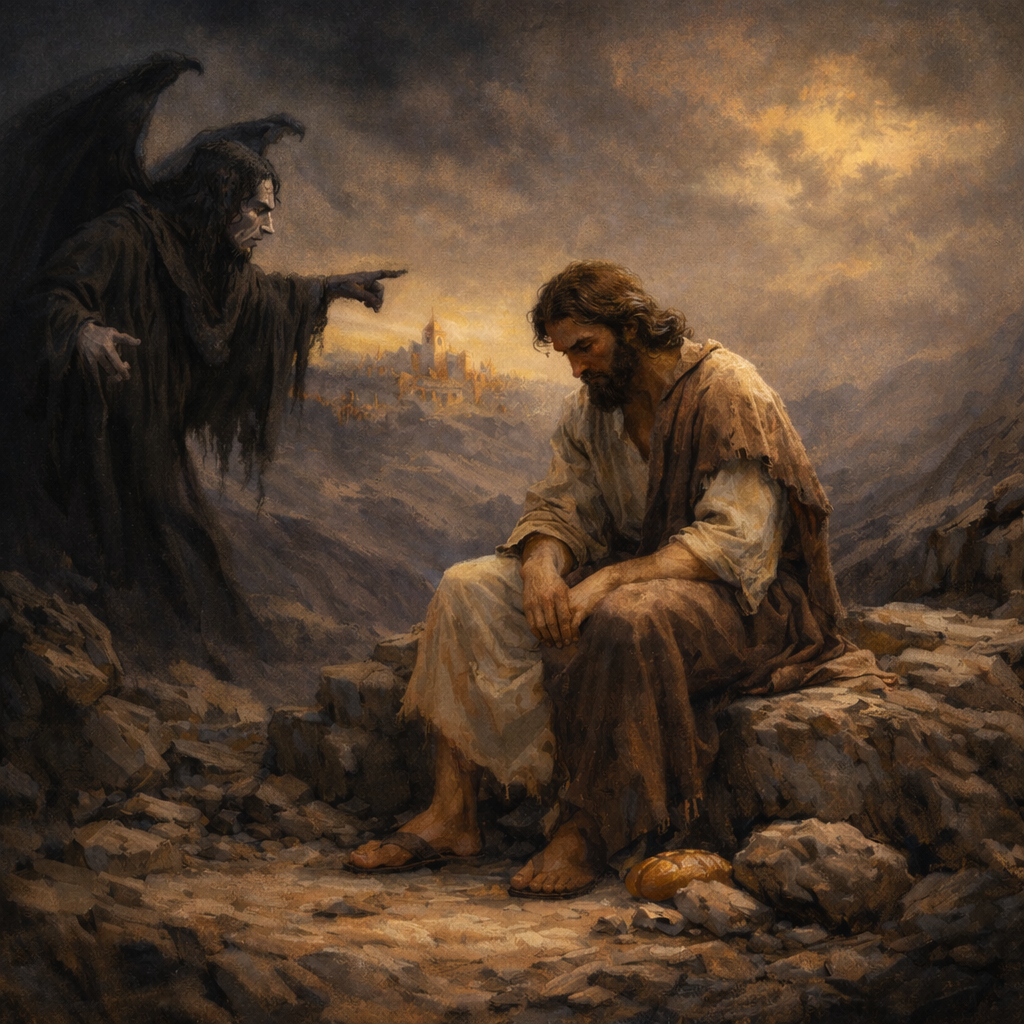
Thursday, February 26, 2026 – Matthew 4:1-11
Devotional Thought
Key Verse: “Jesus answered, ‘It is written: Man shall not live on bread alone, but on every word that comes from the mouth of God.’” — Matthew 4:4
The wilderness is quiet.
No crowds.
No applause.
No affirmation.
Just hunger.
Just silence.
Just the question: What do you really trust?
Jesus enters the wilderness full of the Spirit. Not abandoned. Not lost. Led. And in that barren place, the tempter comes — not with obvious evil, but with reasonable shortcuts.
Turn stones into bread.
Prove who you are.
Take control of the kingdoms.
Each temptation invites Jesus to secure life without trust.
But Jesus refuses.
He does not argue with appetite.
He does not debate identity.
He returns to the Word.
“Man shall not live on bread alone…”
The wilderness exposes what sustains us.
Going Deeper
Scripture Reading
Matthew 4:1–11 (NLT) — 1 Then Jesus was led by the Spirit into the wilderness to be tempted there by the devil. 2 For forty days and forty nights he fasted and became very hungry. 3 During that time the devil came and said to him, “If you are the Son of God, tell these stones to become loaves of bread.” 4 But Jesus told him, “No! The Scriptures say, ‘People do not live by bread alone, but by every word that comes from the mouth of God.’” 5 Then the devil took him to the holy city, Jerusalem, to the highest point of the Temple, 6 and said, “If you are the Son of God, jump off! For the Scriptures say, ‘He will order his angels to protect you. And they will hold you up with their hands so you won’t even hurt your foot on a stone.’ ” 7 Jesus responded, “The Scriptures also say, ‘You must not test the Lord your God.’” 8 Next the devil took him to the peak of a very high mountain and showed him all the kingdoms of the world and their glory. 9 “I will give it all to you,” he said, “if you will kneel down and worship me.” 10 “Get out of here, Satan,” Jesus told him. “For the Scriptures say, ‘You must worship the Lord your God and serve only him.’” 11 Then the devil went away, and angels came and took care of Jesus.
Historical Context
Matthew presents Jesus as the true Israel and the new Adam. Just as Israel wandered in the wilderness for forty years, Jesus spent forty days in the desert. Where Israel grumbled and doubted, Jesus trusts and obeys. The temptations echo Israel’s failures:
- Hunger and provision (Exodus 16)
- Testing God’s protection (Exodus 17)
- Idolatry and power (Exodus 32)
Matthew’s Jewish audience would have recognized the pattern instantly. Jesus succeeds where Israel failed.
Literary Context
This scene follows right after Jesus’ baptism, where the Father declares, “This is my beloved Son.”
The wilderness tests that identity.
“If you are the Son of God…”
The structure of the temptations escalates:
- Personal need (bread)
- Public validation (temple)
- Political power (kingdoms)
Each temptation questions whether trust in the Father is enough.
Theological Context
The wilderness is not a detour. It is formation. Temptation itself is not sin. It is the testing of trust.
Jesus resists not through willpower alone, but through being rooted in Scripture. He draws from Deuteronomy — the book Israel received in its wilderness season.
The victory of Christ in the desert is not just an example; it is a substitution. Where humanity failed, Christ stands faithful. Because of Him, our wilderness does not define us.
It forms us.
Key Insights
- The wilderness reveals what truly sustains us.
- Temptation often offers shortcuts to control.
- Identity is tested in silence, not in applause.
- Jesus’ obedience secures our hope.
- Temptation reveals what we trust.
Looking In the Mirror
What feels scarce in your life right now?
Approval?
Security?
Control?
Provision?
Where are you tempted to take shortcuts instead of trusting?
Sit quietly today and ask:
What am I living on?
Bread alone — or the Word of God?
Leave a Reply